IGNOU Grievance Portal 2026: Students enrolled at Indira Gandhi National Open University (IGNOU) may sometimes face issues related to admission, assignments, examinations, results, study material, registration, re-registration, certificates, regional centres or other student services. When a problem is not resolved through the normal support channels, students can use the IGNOU Grievance Portal, known as iGRAM.
The IGNOU Grievance Redressal and Management system, commonly called iGRAM, has been developed to provide students with an online platform for submitting grievances and tracking their responses. IGNOU describes iGRAM as a dedicated mechanism intended to help resolve learner problems and provide an effective feedback and grievance-redressal system.
The portal is especially useful when you have already tried to resolve an issue through the appropriate department or centre and need to formally register a complaint with IGNOU.
What Is the IGNOU Grievance Portal?
The IGNOU Grievance Portal, or iGRAM, is the university’s online grievance redressal platform for registered students.
IGNOU says that students are entitled to timely service, reliable and accurate information, competent assistance, respectful treatment and an effective feedback mechanism. iGRAM was developed with the objective of providing a system through which student problems can be addressed efficiently.
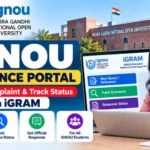
The portal provides options including New Query/Grievance, Track Grievance, Response Status, and other related services. The official portal also states that only registered IGNOU students are allowed to submit grievances through iGRAM.
In simple terms, if something related to your IGNOU studies is not going as expected and you need to formally bring the matter to the university’s attention, iGRAM can be one of the channels you use.
Official IGNOU Grievance Portal Link
Students searching for the “IGNOU grievance portal”, “IGNOU complaint portal”, “IGNOU iGRAM”, or “IGNOU complaint status” should use the official website:
It is better to use the official IGNOU domain instead of relying on third-party websites that claim to provide grievance services.
IGNOU’s official website also lists Student Grievances (iGRAM) as one of its student services.
Important IGNOU Grievance Portal Information
| Information | Details |
|---|---|
| Portal Name | IGNOU Grievance Redressal and Management (iGRAM) |
| University | Indira Gandhi National Open University |
| Purpose | Submission and redressal of student grievances |
| Official Portal | https://igram.ignou.ac.in/ |
| Who Can Submit | Registered IGNOU students |
| Main Services | New Query/Grievance, Track Grievance, Response Status |
| Common Issues | Admission, assignments, examination, results, study material, registration and student services |
| Student Support Centre | IGNOU Student Service Centre |
| IGNOU Headquarters | Maidan Garhi, New Delhi |
| Official IGNOU Website | https://www.ignou.ac.in/ |
| Best Practice | Keep your enrolment number and supporting documents ready |
The exact grievance categories and portal options can change, so students should always check the current iGRAM website when submitting a complaint.
What Types of Problems Can You Report Through iGRAM?
IGNOU students deal with many different administrative and academic processes. As a result, the nature of grievances can vary from student to student.
Some common examples include:
- Admission-related issues
- Re-registration problems
- Assignment-related issues
- Assignment marks not updated
- Examination-related queries
- Result-related problems
- Study material issues
- Student registration issues
- Regional Centre-related concerns
- Counselling-related problems
- Certificate-related matters
- Academic support issues
- Other student-service complaints
However, not every issue necessarily needs to be submitted through iGRAM. IGNOU maintains a broader grievance-redressal structure in which particular issues may be handled by the concerned Regional Centre, Student Registration Division, examination authorities, study-material division or another appropriate department.
This is important because sending a grievance to the wrong authority may take longer to resolve.
How to Submit a Grievance on the IGNOU Grievance Portal?
The process of submitting an IGNOU grievance through iGRAM is designed to be straightforward.
Step 1: Visit the Official iGRAM Website
Open:
The homepage contains options for submitting a new query or grievance and tracking an existing grievance.
Step 2: Select “New Query / Grievance”
On the iGRAM homepage, look for the New Query / Grievance option.
This is the starting point for registering a new complaint.
Step 3: Select the Grievance Category
You will need to choose the category that best matches your problem.
Selecting the correct category is important because it helps direct your complaint to the appropriate area.
For example, an examination-related complaint should be described as an examination issue rather than a general admission problem.
Step 4: Select the Subject
The portal also asks users to select a relevant subject.
Choose the option that most closely represents the issue you are experiencing.
If you are unsure which category or subject fits your problem, read the available choices carefully and select the closest applicable option.
Step 5: Enter Your Grievance Details
After selecting the relevant options, provide a clear description of your problem.
Try to explain:
- What happened
- When the issue started
- Which programme you are enrolled in
- Your enrolment number, where requested
- Your Regional Centre or Study Centre, if relevant
- Any previous communication about the issue
- What resolution you are expecting
IGNOU’s official FAQ explains the basic iGRAM process as visiting the portal, selecting New Query/Grievance, selecting the grievance category and subject, clicking “Next”, and then filling in the query or grievance details.
How to Write a Good IGNOU Grievance?
A well-written grievance is much easier for the concerned authority to understand.
Instead of writing:
“My result is not updated. Please solve.”
A better explanation would include the relevant details, such as:
“I am enrolled in [programme] with enrolment number [number]. I appeared for the relevant examination and my result has been updated, but the marks for [course code] are not showing in my academic record. I have checked the available result information and would request the concerned department to verify and update the record.”
The second version gives the university a clearer starting point.
Keep your grievance factual, polite and specific.
What Documents Should You Keep Ready?
Depending on the nature of your complaint, supporting documents may be useful.
You may want to keep copies of:
- IGNOU ID card
- Enrolment details
- Fee receipt
- Assignment submission receipt
- Examination form details
- Examination hall ticket
- Result or grade-card screenshot
- Previous correspondence
- Regional Centre communication
- Payment confirmation
- Application form
- Relevant certificates
- Screenshots showing the problem
Do not upload unnecessary personal information. Provide only documents that are relevant to the grievance and requested by the applicable process.
How to Track IGNOU Grievance Status?
One of the useful features of iGRAM is that students can track the status of a grievance after submitting it.
The official iGRAM homepage provides a Track Grievance Response Status option.
If you have already submitted a grievance, keep your grievance-related details or reference information safely. You may need them when checking the status or communicating about the same issue later.
It is also a good idea to take a screenshot or save the confirmation information after submitting your complaint.
What Happens After You Submit a Grievance?
Submitting a grievance does not necessarily mean that the issue will be resolved instantly.
The complaint may need to be reviewed by the concerned authority or department. Depending on the subject, the matter may require verification of university records or coordination between different offices.
IGNOU’s Student Evaluation Division explains that it handles result processing and also addresses student grievances through channels including iGRAM, the Public Grievance Portal, email, telephone and other modes.
This means that some complaints can take longer than others depending on their complexity.
For example, a simple information request may be easier to resolve than a complaint involving examination records, assignment marks, registration history or document verification.
Does iGRAM Solve Every IGNOU Problem?
Not necessarily.
iGRAM is an important grievance-redressal mechanism, but different IGNOU matters may be handled by different authorities.
IGNOU’s published grievance guidance identifies different authorities for different types of student issues. For example, matters involving identity cards, fee receipts, bonafide certificates, migration certificates and certain corrections may be handled by the concerned Regional Centre, while other matters are directed to specific divisions or departments.
Therefore, before submitting a grievance, it is useful to understand which department is responsible for the issue.
If you have a straightforward question that can be answered by your Regional Centre, contacting the Regional Centre directly may sometimes be more appropriate.
IGNOU Student Service Centre
IGNOU also has a dedicated Student Service Centre (SSC) at the university headquarters.
According to IGNOU’s official information, the Student Service Centre acts as an interface between learners and the university. It provides support, information and grievance-redressal assistance.
IGNOU’s published contact information lists the Student Service Centre for general enquiries and student grievances, including telephone numbers and email contacts.
Students should check the latest information on the official IGNOU website before using contact details because contact information and responsibilities can be updated.
IGNOU Grievance Portal vs Regional Centre
Students sometimes wonder whether they should contact iGRAM or their Regional Centre.
The answer depends on the problem.
A Regional Centre may be the more appropriate first point of contact for issues directly connected with local student support, such as certain identity-card, fee-receipt, certificate, address-correction or study-centre matters.
iGRAM can be useful when you need to formally register a grievance and track its response.
IGNOU’s published grievance guidance specifically provides a “whom to contact for what” framework, which shows that different types of problems may be assigned to different authorities.
Tips Before Submitting an IGNOU Complaint
Before pressing the final submission button, take a few minutes to review your complaint.
Use the Correct Enrolment Number
Make sure your enrolment number is accurate.
Select the Correct Category
Choose the category and subject that best match your issue.
Explain the Problem Clearly
Avoid writing a very short complaint that does not provide enough information.
Mention Important Dates
If your complaint concerns an assignment submission, examination, admission or application, mention the relevant date when possible.
Keep Proof
Save screenshots, receipts, acknowledgement numbers and other relevant evidence.
Remain Professional
A polite and factual complaint is generally more useful than an emotional or aggressive message.
Do Not Submit Multiple Identical Complaints
If you have already registered a grievance, first check its status before submitting several duplicate complaints about the same issue.
Common IGNOU Grievances
Some issues appear repeatedly among distance and online-learning students.
IGNOU Assignment Marks Not Updated
Students may submit an assignment but not see the marks immediately. Assignment evaluation and marks transmission can take time. IGNOU’s Student Evaluation Division is responsible for processing various components of student evaluation, including assignments and results.
IGNOU Result Problem
If a result appears incomplete or an expected component is missing, students should first verify the available result and grade-card information and then raise the matter through the appropriate channel if necessary.
IGNOU Admission Problem
Issues involving admission confirmation, programme registration or related information may require verification of university records.
IGNOU Study Material Issue
Students who have not received expected study material can check the relevant IGNOU support channels before submitting a grievance.
IGNOU Examination Issue
Examination-related matters can involve exam forms, hall tickets, examination centres, results, evaluation or related services. The correct department should be identified based on the nature of the problem.
Important IGNOU Links
| Purpose | Official Link |
|---|---|
| IGNOU Grievance Portal / iGRAM | https://igram.ignou.ac.in/ |
| IGNOU Official Website | https://www.ignou.ac.in/ |
| IGNOU Student Services | https://www.ignou.ac.in/pages/4 |
| IGNOU Student Zone | https://www.ignou.ac.in/ignou/studentzone/aadharnumber/introduction |
| Student Grievances | Available through the IGNOU Student Services section |
| IGNOU FAQs | Available through the official IGNOU website |
| IGNOU Regional Centres | Available through the official IGNOU website |
For the quickest access to the grievance system, use the official iGRAM portal directly:
FAQ about IGNOU Grievance Portal 2026
What is the IGNOU Grievance Portal?
The IGNOU Grievance Portal is called iGRAM, which stands for IGNOU Grievance Redressal and Management. It is an online platform designed to help registered students submit grievances and track responses.
Who can submit a grievance on iGRAM?
The official iGRAM portal states that only registered IGNOU students are allowed to submit grievances through the platform.
How do I submit a complaint on the IGNOU grievance portal?
Visit the iGRAM website, select New Query / Grievance, choose the relevant grievance category and subject, and then provide the details of your complaint. IGNOU’s official FAQ describes this process in its student-support information.
Can I track my IGNOU grievance online?
Yes. The iGRAM portal provides a Track Grievance Response Status option for checking the status of a submitted grievance.
What information should I include in an IGNOU grievance?
Include relevant details such as your enrolment number, programme, Regional Centre or Study Centre where applicable, the nature of the issue, important dates and any previous communication related to the matter.
Can I complain about missing IGNOU assignment marks?
If you have a genuine issue involving assignment evaluation or marks, you can use the appropriate IGNOU grievance channel. However, assignment evaluation and marks transmission can take time, so first verify whether the marks have already been updated through the relevant IGNOU result or assignment-status service.
Should I contact my Regional Centre before using iGRAM?
It depends on your issue. Some matters are specifically handled by Regional Centres, while iGRAM provides a broader grievance-redressal mechanism. IGNOU publishes guidance identifying which authority should be contacted for different types of issues.
How long does IGNOU take to resolve a grievance?
There is no single resolution time that applies to every grievance. The time can depend on the type of complaint, the department involved, verification requirements and other circumstances.
What should I do if my IGNOU grievance is not resolved?
If your grievance remains unresolved, check its status through iGRAM and review the applicable IGNOU support or escalation channels. Keep your grievance reference details and supporting documents ready when following up.
Is iGRAM an official IGNOU portal?
Yes. iGRAM is an IGNOU-developed grievance-redressal platform, and IGNOU’s official website lists Student Grievances (iGRAM) as one of its student services.
Can I submit a grievance without being an IGNOU student?
The official iGRAM website states that only registered IGNOU students are allowed to submit grievances through the portal.
Conclusion
The IGNOU Grievance Portal is an important online facility for students who need to formally report a problem or seek assistance with an unresolved academic or administrative issue. The platform, known as iGRAM, allows registered IGNOU students to submit grievances online and provides an option to track the response status.
If you are facing a problem with your admission, assignment, examination, result, registration, study material or another student service, first identify the department or authority responsible for the issue. For matters that require formal grievance registration, iGRAM can provide a convenient way to communicate the problem to IGNOU.
The official portal is:
When submitting a complaint, provide accurate information, explain the issue clearly and keep your supporting documents and grievance details safe. Also remember that different IGNOU issues may be handled by different departments or Regional Centres, so choosing the right channel can help avoid unnecessary delays.
For the latest information, students should always rely on the official IGNOU website and official student-support portals rather than unofficial websites. IGNOU itself maintains iGRAM as part of its broader student grievance-redressal system, alongside other support channels such as the Student Service Centre and Public Grievance Portal.